
Rheumatoid Arthritis: When Mornings Are Hardest
Immune modulation without immunosuppression
When morning stiffness steals hours from your day and joint pain limits everything you love, there's a different approach. MSC therapy works with your immune system—not against it—to reduce inflammation and restore function.
Can stem cell therapy help rheumatoid arthritis?
Some guests with rheumatoid arthritis explore mesenchymal stem cell protocols as part of a broader care plan. Rheumatoid arthritis is a chronic autoimmune condition with no cure; this is not FDA-approved, and any benefit is unproven. Care is delivered by licensed physicians at our Sterling-certified partner clinic, and you should continue working with your own rheumatologist.
Educational information only — not medical advice, and individual results vary. Treatment is delivered by licensed physicians at our Sterling-certified partner clinic. How care is governed




"Every Morning Is a Battle Before the Day Begins"
The stiffness that takes hours to fade. The swollen joints that make simple tasks feel impossible. The fatigue that never fully lifts. RA doesn't just affect your joints—it affects your entire life.
"I was losing my independence. Buttoning my shirt, opening a jar, holding my grandchildren—everything hurt. The medications helped some, but the side effects were becoming their own problem."— Margaret, 58, RA Guest
There's another approach.
MSC therapy works differently—modulating your immune system instead of suppressing it. Research shows it may help reduce inflammation and improve function without compromising your body's ability to fight infection.
The Hidden Cost of Immunosuppression
What long-term DMARD and biologic use can mean
- Increased infection risk—even common infections can become serious
- Liver and kidney monitoring required due to medication toxicity
- Potential blood cell abnormalities requiring regular testing
- Medication costs of $5,000-$50,000+ per year for biologics
MSC therapy offers a different philosophy—working with your immune system to restore balance, rather than suppressing it entirely. Many guests reduce or eliminate their dependence on immunosuppressive medications.
Why Your Immune System Attacks Your Joints
Rheumatoid arthritis is an autoimmune condition where your immune system mistakenly attacks the synovium—the lining of your joints. This triggers a cascade of inflammation that damages cartilage and bone over time.
The RA Cascade
- 1 Immune system mistakenly targets joint tissue
- 2 T-cells and B-cells attack the synovium
- 3 Inflammatory cytokines flood the joint
- 4 Synovium thickens, causing pain and stiffness
- 5 Cartilage and bone erode over time
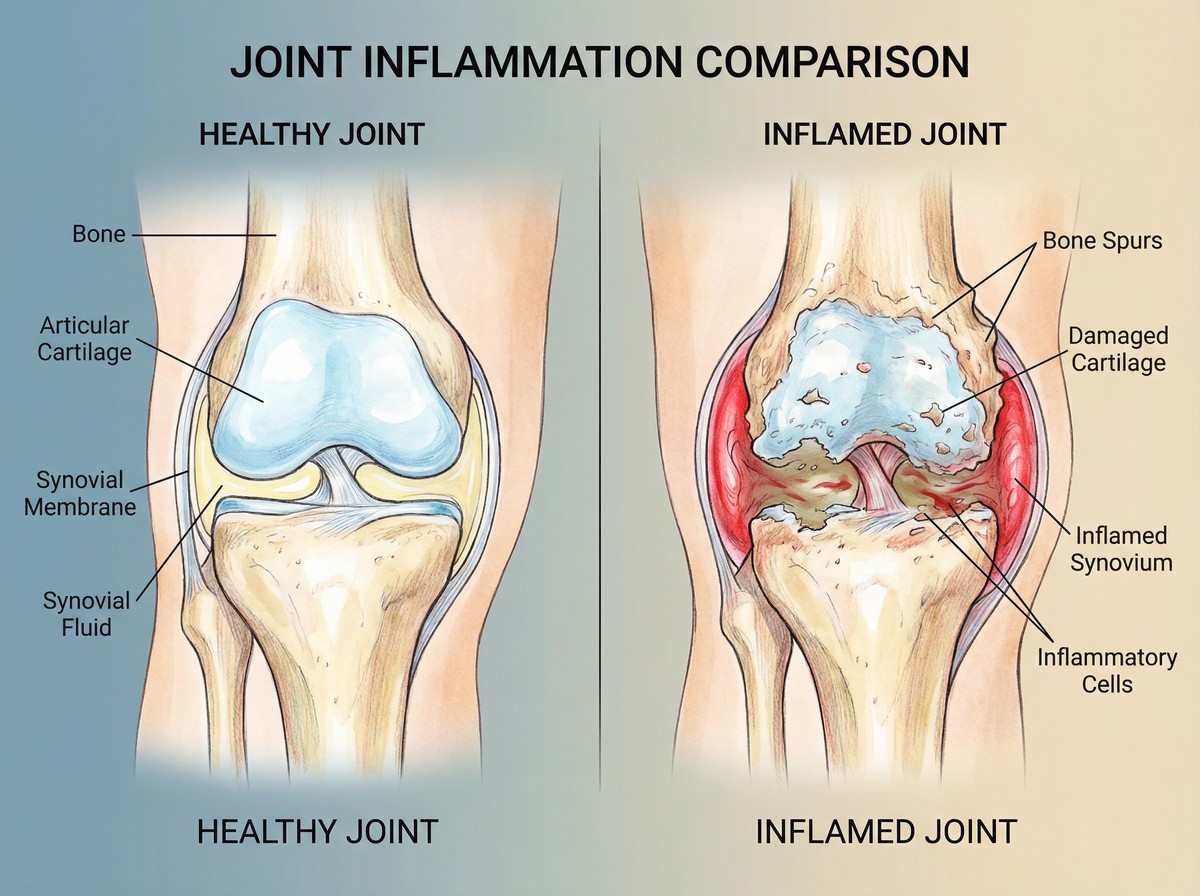
MSCs can interrupt this cascade at multiple points, modulating the immune response and reducing inflammation without suppressing immunity entirely.
How MSCs Modulate the Immune Response
T-Cell Regulation
MSCs modulate overactive T-cells that attack healthy joint tissue, reducing the autoimmune response at its source.
Cytokine Balance
MSCs release anti-inflammatory factors that reduce TNF-α and IL-6 levels, key drivers of RA inflammation.
B-Cell Modulation
MSCs help regulate B-cells that produce autoantibodies, potentially reducing joint damage progression.

"After 12 years on methotrexate and two different biologics, I was tired of the constant infections and feeling rundown. Three months after MSC therapy, my morning stiffness went from 3 hours to 30 minutes. I'm gardening again, holding my grandchildren, living my life."

*Name changed for privacy. Photo may feature a model. Individual results may vary.
What the Research Shows
Peer-reviewed studies demonstrate meaningful outcomes for RA guests
Disease Activity Score (DAS28) Improvement
Lower score = less disease activity
Based on Lopez-Santalla et al., Stem Cells Transl Med (2020), doi:10.1002/sctm.20-0025
Lopez-Santalla et al. (2020)
Stem Cells Translational Medicine
Phase I/II clinical trial of systemic allogeneic MSC administration in refractory RA patients, demonstrating safety and clinical improvement.
0 patients
Wang et al. (2019)
Drug Design, Development and Therapy
Prospective phase I/II study demonstrating efficacy and safety of UC-MSC therapy for RA patients with improvements in disease activity markers.
0 patients
DOI: 10.2147/DDDT.S225613 PMID: 31908418
Ghoryani et al. (2019)
Biomedicine & Pharmacotherapy
Successful clinical trial in Iran showing amelioration of clinical symptoms in patients with refractory RA following autologous BM-MSC treatment.
0 patients
DOI: 10.1016/j.biopha.2018.12.109 PMID: 30611947
Understanding Your Options
Compare conventional immunosuppression with regenerative approaches
Note: MSC therapy is often used alongside reduced doses of conventional medications. Our specialists work with your rheumatologist to create an integrated care plan.
Is MSC Therapy Right for Your RA?
Our specialists evaluate each guest individually to ensure the best possible outcomes
May Be a Good Candidate
Guests who often respond well to MSC therapy:
- Diagnosed with rheumatoid arthritis (seropositive or seronegative)
- Experiencing side effects from current medications
- Seeking to reduce immunosuppressant dependence
- Inadequate response to DMARDs or biologics
- Concerned about long-term medication effects
May Need Different Approach
Cases requiring additional evaluation:
- Active infection or sepsis
- Severe immunodeficiency conditions
- Active malignancy or recent cancer treatment
- Pregnancy or planning to become pregnant
Your Path to Relief
Most guests notice improvement within the first month
Initial Response
Many guests notice reduced morning stiffness within the first two weeks. Inflammation markers begin to decrease.
Growing Relief
Joint swelling diminishes. Daily tasks like opening jars, buttoning shirts, and writing become easier.
Significant Improvement
ACR20/50 response criteria often met. Many guests report substantial reduction in pain and improved mobility.

Sustained Benefits
Continued immune modulation. Studies show improvements can be maintained long-term with proper care.

Ready to Explore Your Options?
Take the first step toward immune balance. Our free assessment helps determine if MSC therapy is right for your rheumatoid arthritis.
Your $5,999 Discovery includes a $5,000 credit toward any program — making your net investment just $999.
No obligation. Appointments available within 48 hours. Insurance verification included.
Questions guests ask about rheumatoid arthritis
Can stem cell therapy cure rheumatoid arthritis?
No. Rheumatoid arthritis is a chronic autoimmune condition with no known cure, and Sterling makes no cure claim. Research into cell-based approaches is exploratory. This information is educational; continue your care with your rheumatologist.
Should I stop my DMARDs or biologic medication?
No. Nothing here is a reason to change or stop prescribed disease-modifying or biologic medication. Any change must be made with your treating rheumatologist; Sterling coordinates travel and support, not your medical treatment.
Is stem cell therapy for rheumatoid arthritis approved by the FDA?
Stem cell therapies are not FDA-approved in the United States for rheumatoid arthritis, and the FDA has not evaluated these treatments. Care is delivered abroad by licensed physicians at our Sterling-certified partner clinic in Bangkok, Thailand. The information here is educational, is not medical advice, and individual results vary.
Am I a candidate for regenerative therapy for rheumatoid arthritis?
Candidacy depends on your diagnosis, imaging or test results, overall health, and goals — not everyone is a suitable candidate. The free Sterling assessment reviews your situation in a few minutes, and final eligibility is confirmed on-site after comprehensive bloodwork and a consultation with the physicians at our partner clinic.
How much does treatment cost?
The Discovery Experience is $5,999 and includes a $5,000 credit toward any extended program chosen on the same trip. Because the recommended approach is personalised after your on-site bloodwork and physician assessment, extended-program costs are shared in context rather than published in advance. Begin with the free Sterling assessment to understand the path that fits you.
Who provides the treatment?
Sterling Longevity is a wellness-travel concierge, not a medical provider. We vet partner clinics, coordinate your entire journey, and support you for 12 months — while the treatment itself is delivered by independently licensed physicians at our Sterling-certified partner clinic. You can read how care is governed.
How soon might I notice a change after treatment?
Timelines vary by individual and condition. Some guests describe gradual changes over several weeks to a few months, while others notice less. Regenerative outcomes are not guaranteed, and no specific result can be promised.
Can I travel home after treatment?
Treatments are delivered on an outpatient basis during your stay in Bangkok, and most guests fly home as planned once their program is complete. Your travel timing is confirmed with the physicians at our partner clinic, and Sterling coordinates airport transfers plus 12 months of follow-up support.