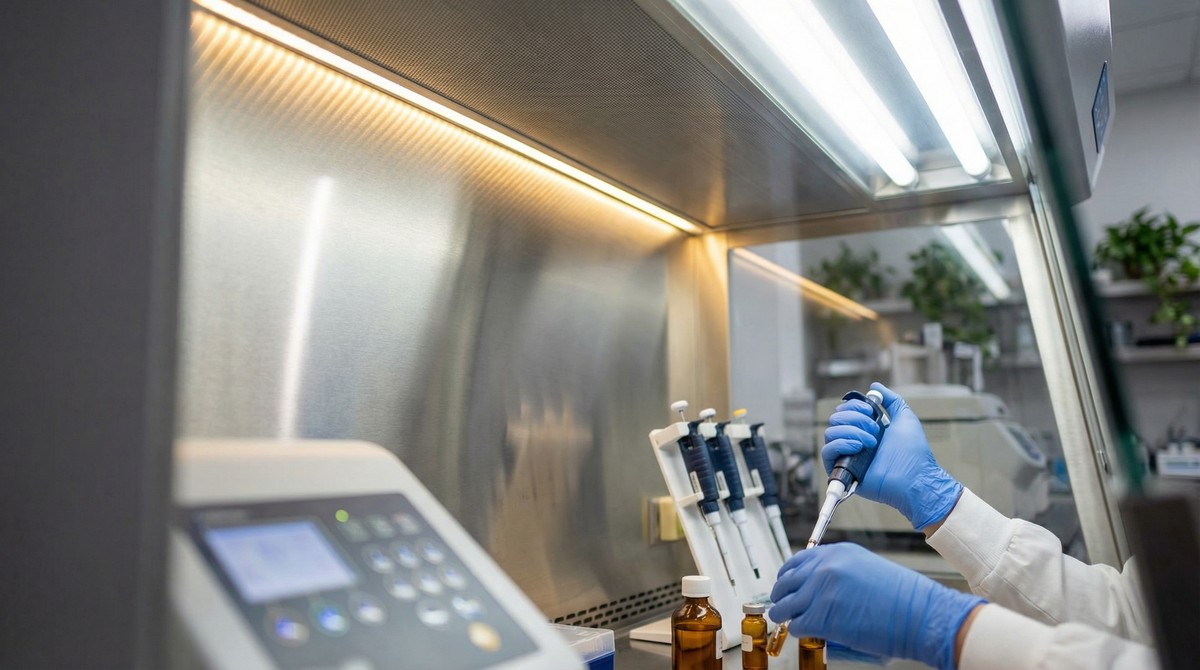
How to Tell the Difference Between Cells That Heal and Cells That Don't
Not all stem cells are equal. Viability, donor age, and preparation method are the variables the published research agrees on — and the variables a guest can actually verify before treatment.
Compare All ClinicsKey Takeaways
- Cell viability matters more than raw count—50 million live cells can outperform 100 million degraded ones
- Fresh cells maintain 95%+ viability vs. 60-70% for frozen/thawed cells
- Neonatal umbilical cord cells have 2-3× higher proliferative capacity than aged bone marrow cells
- The secretome (healing signals) from fresh cells is significantly more potent
- 73% of guests maintain pain relief at 5 years with optimized, high-quality cell therapy
The Cell Count Trap
When researching stem cell therapy, you've likely encountered clinics advertising "100 million cells" or even "200 million cells." The numbers are impressive. They sound powerful. And they create a single-variable picture of a multi-variable process.
Cell count alone is not a quality measure. The published research treats it as one input alongside viability, donor age, passage number, and preparation method.
Why Cell Counts Get Centre Stage
Big numbers are easy to compare. "100 million stem cells" reads as more than "50 million stem cells," and most consumer-facing marketing is built on that intuition. The harder questions — the ones that actually predict outcome — rarely make the brochure:
- What percentage of those cells are still alive at the moment of administration?
- How many were lost across freezing, storage, and thawing?
- What condition are the surviving cells in (potency, secretome, senescence)?
- How old were the donors, and what tissue source were the cells drawn from?
The “Up To” Problem
Phrases like “up to 100 million cells” are doing significant work. They allow advertised maximums to stand in for verified delivered doses, leave variable batch quality unaccounted for, and let viability losses sit invisibly behind a single impressive number.
A carton of milk contains a billion bacteria. That doesn't mean drinking it will improve your gut health.
Industry analyses of low-cost stem cell tourism markets have documented batches advertised as "100 million cells" arriving with post-thaw viability below 70% — leaving roughly 65 million functional cells, with the remainder consisting of cellular debris that can drive inflammatory rather than regenerative responses.1
The Viability Factor: The Hidden Variable
Cell viability is the percentage of living, functional cells in a preparation. The published consensus is that it is the single most important quality metric in MSC therapy, and the metric a guest is most often asked to take on faith.2
Understanding the Math
| Preparation | Advertised Count | Viability | Living Cells Delivered |
|---|---|---|---|
| Frozen, post-thaw (typical budget batch) | 100 million | ~65% | ~65 million |
| Fresh UC-MSC at Sterling-certified partner clinics | 50 million | ≥95% | ~47.5 million |
Read on count alone, the frozen preparation looks ahead. But living cell count is only one of three variables that determine therapeutic effect.
The Effective Therapeutic Units (ETU) Model
Cells that survive cryopreservation — especially suboptimal cryopreservation — are often metabolically stressed, with reduced paracrine signalling capacity. To make the comparison honest, our research brief introduces an educational model that combines the three variables the published literature treats as compounding: viability, donor age, and secretome integrity.3
ETU = Advertised Count × Viability × Donor-Age Factor × Secretome Factor
| Preparation | Calculation | Effective Therapeutic Units |
|---|---|---|
| Frozen UC-MSC, budget batch | 100M × 0.65 × 1.0 × 0.7 | 45.5 million |
| Autologous bone marrow, 60+ donor | 50M × 0.90 × 0.6 × 1.0 | 27 million |
| Fresh UC-MSC at Sterling-certified partner clinics | 50M × 0.95 × 1.0 × 1.0 | 47.5 million |
Once secretome integrity is included, 50 million fresh cells edge out 100 million frozen cells. The ETU model is a Sterling-developed educational illustration; the multipliers are conceptual estimates anchored on published research, not peer-reviewed clinical measurements.
Why Fresh Cells Are More Potent
The debate between fresh and cryopreserved cells has raged in stem cell research for decades. The scientific consensus is nuanced: properly cryopreserved cells can maintain therapeutic equivalence to fresh cells—when optimal protocols are followed. The problem? Most clinics don't follow optimal protocols.
Metabolically Stressed
Frozen cells enter metabolic stasis. Upon thawing, mitochondrial function is often impaired, requiring 24-48 hours of recovery culture to restore full ATP production.
Genomically Damaged
During freezing, intracellular and extracellular ice crystals form, puncturing cell membranes and organelles. This causes DNA fragmentation that impairs cell function.
Senescent
Cryopreservation stress leads to shortened telomeres and reduced proliferative capacity. These aged cells have diminished regenerative potential.
Secretome-Depleted
Cells exhaust their paracrine signaling reserves during the freeze-thaw stress response, leaving them with exhausted healing signals when you need them most.
The Freeze–Thaw Viability Cascade
Each step of cryopreservation, storage, thawing, and shipping subtracts living cells from the original harvest. The figures below are cumulative percentage of original cells still alive at each stage, drawn from the industry data summarised in our research brief on fresh vs frozen MSCs.4
That ~65% endpoint is the input the ETU model uses for budget frozen preparations — and is the published number that justifies why advertised cell count and delivered cell count are not the same conversation.4,5
The ISCT Threshold: A Published Quality Baseline
The International Society for Cell & Gene Therapy (ISCT) sets ≥80% viability as the minimum threshold for clinical use of mesenchymal stromal cells. This isn't an arbitrary line — viability below it correlates in the published literature with reduced engraftment, diminished immunomodulatory capacity, and a higher risk of inflammatory adverse responses.2,5
Ask any clinic: "What's your viability percentage at injection?"
When a clinic cannot—or will not—provide a Certificate of Analysis showing viability percentage, testing methodology, and testing date, they are asking you to trust without verifying.
See It For Yourself
Sterling-certified partner clinics in Bangkok meet every standard described above. Every guest is welcome to tour the facility before treatment.
Questions That Expose Quality Gaps
Before committing to stem cell therapy with any provider—including us—demand answers to these questions:
What's your cell viability percentage at injection?
A reputable clinic will provide a Certificate of Analysis showing exact viability percentage, testing methodology (flow cytometry preferred), and testing date within 24-48 hours of administration.
Red flag: Vague responses like "high viability" or "industry standard"Fresh or frozen cells?
If frozen: What cryoprotectant concentration? What was post-thaw viability? Was a recovery culture period observed? If fresh: How long between harvest and administration?
What's the cell source and donor age?
Umbilical cord tissue (neonatal): Maximum potency. Adult bone marrow/adipose: Potency decreases with donor age. Passage number: Lower is better (P1-P2 optimal, FDA recommends P4 or lower).
Where is your lab located?
On-site labs enable fresh cell preparation. Off-site or international shipping typically requires freezing, compromising cell viability and potency.
Can I see my Certificate of Analysis?
Every guest has the right to review: total cell count, viability percentage, immunophenotype confirmation (CD105+, CD73+, CD90+, CD45−, CD34−), sterility testing, endotoxin levels, and mycoplasma screening.
If a clinic cannot provide this, walk away.A proper Certificate of Analysis. Every guest at a Sterling-certified partner clinic receives theirs before treatment.
Fresh vs. Frozen: The Quality Gap
The science is clear—freshly processed cells deliver superior therapeutic outcomes.
Not All Stem Cells Are Created Equal
Your body's own stem cells decline with age. A 65-year-old's bone marrow MSCs have approximately 60% of the regenerative capacity of neonatal umbilical cord MSCs. That's why cell source matters as much as cell count.
| Metric | UC-MSCs (Neonatal) | BM-MSCs (Adult) | Adipose MSCs (Adult) |
|---|---|---|---|
| Donor age | Neonatal (0) | Guest (50–80) | Guest (50–80) |
| Proliferation rate | 2–3× higher | Baseline | 1.5× higher |
| Doubling time | 24–36 hrs | 40–60 hrs | 30–50 hrs |
| Doublings before senescence | 10–15+ | 6–8 | 8–10 |
| Immunomodulation | Superior | Strong | Strong |
| HLA expression | Very low | Low | Low |
| Age-related decline | None | Severe after 50 | Significant |
| 10-day fold expansion | 10× | 5.8× (age 60–80) | ~7× |
Based on Choudhery et al. (2014), CRATUS Trial (2017), and Stem Cells International systematic comparison. UC-MSC = umbilical cord mesenchymal stem cells. BM-MSC = bone marrow MSCs.
Cell Source Comparison
Why cell source determines therapeutic outcome.
What the Evidence Shows
High-quality MSC therapy isn't just theory. Peer-reviewed clinical data across thousands of guests demonstrates measurable, lasting outcomes.
Individual results vary. The figures above are drawn from peer-reviewed meta-analyses and long-term follow-up studies of optimised MSC protocols, and represent the published literature — not a guarantee of outcome for any individual guest.6,7,8 Sterling-certified partner clinics use protocols designed to align with the variables associated with these outcomes: high cell viability, fresh preparation, and neonatal cell sources.
What Happens to Dead Cells in Your Lungs?
When stem cells are administered intravenously, approximately 80% pass through your lung capillaries first — a phenomenon called the pulmonary first-pass effect. Live cells still produce therapeutic molecules from there. But dead cells trapped in your lungs release inflammatory signals (DAMPs) that work against your treatment. A 100-million-cell dose at 60% viability means 40 million dead cells entering your pulmonary circulation.
Read the full science: The Pulmonary First-Pass EffectThe Real Math: Effective Therapeutic Units
Why 50 million premium cells outperform 100 million frozen ones.
References
- Industry analyses of low-cost stem cell tourism markets, summarised in Sterling Longevity research brief, Why 50M Premium Cells Outperform 100M Frozen.
- Viswanathan S. et al. Mesenchymal stem versus stromal cells: ISCT MSC committee position statement on nomenclature. Cytotherapy 2019;21(10):1019–1024.
- Brunello G. et al. Mesenchymal stem cell-derived extracellular vesicles in the management of musculoskeletal disorders. Pharmaceutics 2022;14(11):2312 (donor-age effect on MSC secretome).
- Sterling Longevity research brief: Fresh vs Frozen Stem Cells — the ETU model and freeze–thaw cascade (full data table, citations, and disclosures).
- Galipeau J. The mesenchymal stromal cells dilemma — does a negative phase III trial of random donor mesenchymal stromal cells in steroid-resistant graft-versus-host disease represent a death knell or a bump in the road? Cytotherapy 2013;15(1):2–8 (post-thaw recovery requirements).
- Choudhery M.S. et al. Donor age negatively impacts adipose tissue-derived mesenchymal stem cell expansion and differentiation. Journal of Translational Medicine 2014;12:8.
- Hernigou P. et al. Cell therapy of hip osteonecrosis with autologous bone marrow grafting. Indian Journal of Orthopaedics 2009;43(1):40–45 (long-term follow-up of optimised MSC protocols).
- Wang Y. et al. Safety and long-term efficacy of mesenchymal stem cell therapy: pooled analysis of clinical follow-up studies. Stem Cells International (meta-analysis of cartilage and pain outcomes).
The Effective Therapeutic Units (ETU) framework presented on this page is a Sterling-developed educational model designed to illustrate how viability, donor age, and secretome integrity compound. The specific multipliers are conceptual estimates anchored on the published research cited above; they are not peer-reviewed clinical measurements and do not predict outcomes for any individual guest.
I visited two other clinics before Sterling. Neither could tell me their viability percentage or show me a Certificate of Analysis. Sterling handed me the lab report before I even asked. That transparency told me everything I needed to know.
Individual results may vary and are not guaranteed. Name changed for privacy.

Experience the Quality Difference
See the laboratory, meet the physicians at our partner clinics, and review your personalised protocol. Discover why Sterling guests choose quality over quantity — and experience results that speak for themselves.