
Stay Strong. Stay Independent.
Prevent frailty before it starts. Maintain the strength to carry groceries, the energy to play with grandkids, and the mobility to travel or garden — all on your own terms, in your own home.
Start Your Independence DiscoveryCan stem cell therapy help prevent frailty and protect your independence?
Here is the hopeful part: frailty isn’t an inevitable part of getting older — it’s a measurable, often modifiable condition. In randomized controlled trials of mesenchymal stem cell therapy in frail older adults, Golpanian et al. (2017) reported improvement in walking distance and lower inflammation, and Tompkins et al. (2017) reported dose-dependent gains in physical function with no serious adverse events attributed to the therapy. These are study findings, not guarantees; individual results vary, and care is delivered by licensed physicians at our Sterling-certified partner clinic.
Educational information only — not medical advice, and individual results vary. Treatment is delivered by licensed physicians at our Sterling-certified partner clinic. How care is governed
What is Frailty?
Frailty is not normal aging. It's a preventable syndrome that can be addressed.
Weakness
Reduced grip strength measured with a dynamometer, adjusted for sex and BMI.
Slow Gait
Reduced walking speed on a timed 4-meter walk, adjusted for sex and height.
Exhaustion
Self-reported fatigue and feeling that everything requires effort.
Low Activity
Sedentary lifestyle with minimal physical activity or exercise.
Weight Loss
Unintentional loss of >5% body weight in the past year.
The good news? Frailty markers can improve with targeted cellular optimization. Studies show meaningful gains in grip strength, gait speed, and energy.
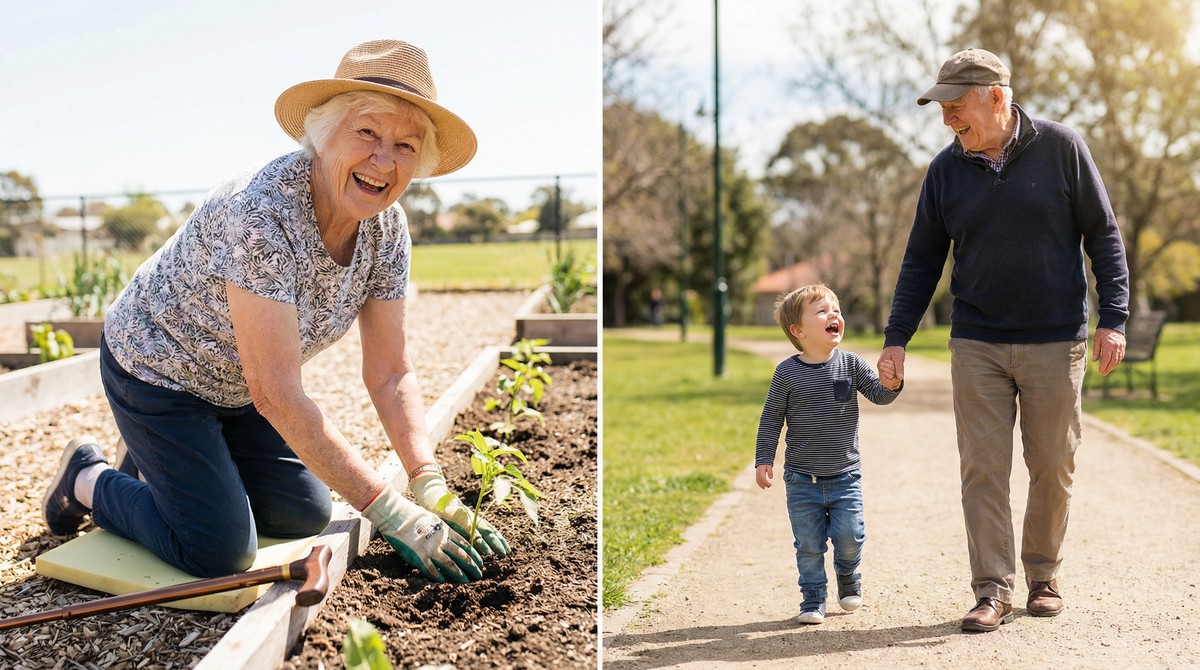
This Is What Independence Looks Like
Real moments of joy, connection, and vitality — staying active on your own terms.


Prevention vs. Treatment
Earlier intervention produces more robust responses. The window for optimal results is widest at the pre-frail stage.
Prevention
- Address cellular senescence before accumulation
- Maintain muscle mass and function
- Preserve metabolic and immune health
Treatment
- Address established frailty syndrome
- Improve function and reduce progression
- Support rehabilitation and recovery
Earlier intervention means better outcomes. Find out if you or your loved one qualifies.
Check Your Candidacy — Free"Giving my father the gift of continued independence was the best decision our family made. He's back to gardening and playing with his grandchildren."Sarah M. Daughter of 72-year-old guest
Researching for a Parent?
We understand this decision often involves the whole family. Here's what you should know:
- Pre-frail individuals respond most robustly to intervention
- Treatment is outpatient with concierge support throughout
- Comprehensive safety profile with 1,000+ clinical trials
- We coordinate with existing physicians and care teams
Functional Outcomes
Results from clinical trials including the landmark CRATUS study.
Gait Speed
Improved walking speed correlates with reduced mortality risk.
Grip Strength
Enhanced muscle function and vitality markers.
Inflammation
Reduction in IL-6 and TNF-α inflammatory markers.
Walking Distance
Improved 6-minute walk test performance.
Questions about frailty prevention
What is frailty, and can it be reversed?
Frailty is a measurable syndrome of reduced strength, slower walking, and lower physiological reserve — and, importantly, it is dynamic and often modifiable (Clegg et al., 2013), not an unavoidable part of ageing. “Reversal” cannot be promised, but the goal is to preserve and rebuild function.
What outcomes have the studies reported?
In randomized controlled trials of mesenchymal stem cells in frail older adults, Golpanian et al. (2017) reported improvement in six-minute walk distance and reduced inflammation, and Tompkins et al. (2017) reported dose-dependent functional improvements with no serious adverse events attributed to the therapy. These are study findings; individual results vary.
Who should consider a frailty-prevention program?
Older adults noticing reduced strength, slower walking, unintended weight loss, fatigue, or unsteadiness — or families planning ahead for a parent. Suitability is confirmed on-site after bloodwork and a consultation with the partner-clinic physicians; not everyone is a candidate.
Who is a candidate for this program?
Sterling’s frailty prevention programs are for healthy adults investing proactively in their long-term health, not for treating a diagnosed disease. Suitability is reviewed in the free Sterling assessment and confirmed on-site after bloodwork and a consultation with the physicians at our partner clinic — not everyone is a suitable candidate.
How much does it cost?
Every journey begins with the Discovery Experience at $5,999, which includes a $5,000 credit toward any extended program chosen on the same trip. Because the right approach is personalised after your on-site assessment, extended-program costs are shared in context rather than published in advance. Begin with the free Sterling assessment to understand the path that fits you.
Who delivers the program, and is Sterling a clinic?
Sterling Longevity is a wellness-travel concierge, not a medical provider. We vet partner clinics, coordinate the journey, and support you for 12 months — while any treatment is delivered by independently licensed physicians at our Sterling-certified partner clinic.
Is regenerative therapy safe?
In a 2012 systematic review of clinical trials (Lalu et al., “SafeCell”), no serious adverse events were attributed to mesenchymal stem cells, with a transient fever the most commonly reported effect. Even so, every medical procedure carries risk; the partner-clinic physicians explain the specifics and obtain your informed consent on-site. These therapies are not FDA-approved in the United States, and individual results vary.
The research behind frailty prevention
Sterling’s frailty-prevention positioning draws on peer-reviewed clinical trials of mesenchymal stem cell therapy for aging frailty. The findings below are the studies’ own results, not outcomes Sterling promises — individual results vary, and treatment is delivered by licensed physicians at our partner clinic.
-
Tompkins et al. (2017)
The Journals of Gerontology: Series A
A phase II randomized, double-blind, placebo-controlled trial reported dose-dependent improvements in functional measures, with benefits sustained at six months and no serious adverse events attributed to the therapy; a 100-million-cell dose showed the best balance of effect and safety.
DOI: 10.1093/gerona/glx137 -
Golpanian et al. (2017)
The Journals of Gerontology: Series A
In a randomized, double-blind, placebo-controlled trial of 15 frail older adults, the mesenchymal stem cell group showed significant improvement in six-minute walk distance and a reduction in the inflammatory marker TNF-α compared with placebo.
DOI: 10.1093/gerona/glx056 -
Clegg et al. (2013)
The Lancet
A widely cited review establishing frailty as a distinct, measurable syndrome that is dynamic and potentially modifiable — the clinical basis for assessing and addressing frailty rather than treating it as inevitable ageing.
DOI: 10.1016/S0140-6736(12)62167-9
These are the findings of the cited studies, not a guarantee of results. Individual outcomes vary; regenerative therapies are not FDA-approved for the conditions discussed, and care is delivered by licensed physicians at our Sterling-certified partner clinic.
Preserve Your Independence
Find out if cellular optimization could help you maintain strength and independence. Takes just 2 minutes.
Check Your Candidacy — Free