
Meniscus Tears: Surgery, and the Alternatives
Non-surgical options for meniscus tears in active adults
You're not ready to give up hiking, tennis, or your morning runs. Regenerative medicine offers a path forward—preserving your meniscus instead of removing it, so you can stay active for years to come.
Can a meniscus tear be treated without surgery?
Stem cell therapy is a non-surgical option some guests explore for certain meniscus tears, especially degenerative tears that are not mechanically locking the knee. Regenerative protocols use injected cells or exosomes intended to support the joint, and suitability is assessed individually. Outcomes vary by individual and are not guaranteed; treatment is delivered by licensed physicians at our Sterling-certified partner clinic.
Educational information only — not medical advice, and individual results vary. Treatment is delivered by licensed physicians at our Sterling-certified partner clinic. How care is governed




"I'm Not Ready to Give Up the Things I Love"
That twisting motion on the tennis court. The sudden pivot on the hiking trail. One moment you're active and confident—the next, your knee is swelling and they're recommending surgery.
"I was told meniscus tears don't heal on their own. That I needed surgery or I'd develop arthritis. But I didn't want to lose part of my knee."— Sarah, 52, Tennis Player
There's another option.
Modern regenerative medicine can support your body's own healing response— potentially avoiding the need for meniscectomy and the arthritis that often follows.
The Hidden Cost of Meniscectomy
What most surgeons don't emphasize enough
- Removing meniscus tissue increases joint stress by up to 350%
- 50% of meniscectomy guests develop osteoarthritis within 10 years
- Once removed, meniscal tissue cannot be replaced—only artificial substitutes
- Repeat surgeries become increasingly complicated with less tissue remaining
Regenerative medicine offers a different philosophy—preserve and heal rather than remove. Research shows it may help avoid the cascade toward joint replacement.
Why Meniscus Location Matters
Your meniscus has two distinct regions with very different healing potential. Understanding which zone your tear is in helps determine the best treatment approach.
Red Zone (Outer Third)
Good blood supply supports natural healing
- Better natural healing capacity
- Responds well to regenerative support
- Often heals without surgery
White Zone (Inner Two-Thirds)
Limited blood supply traditionally meant poor healing
- MSC therapy may enhance healing potential
- Growth factors stimulate repair response
- Research shows promising tissue regeneration
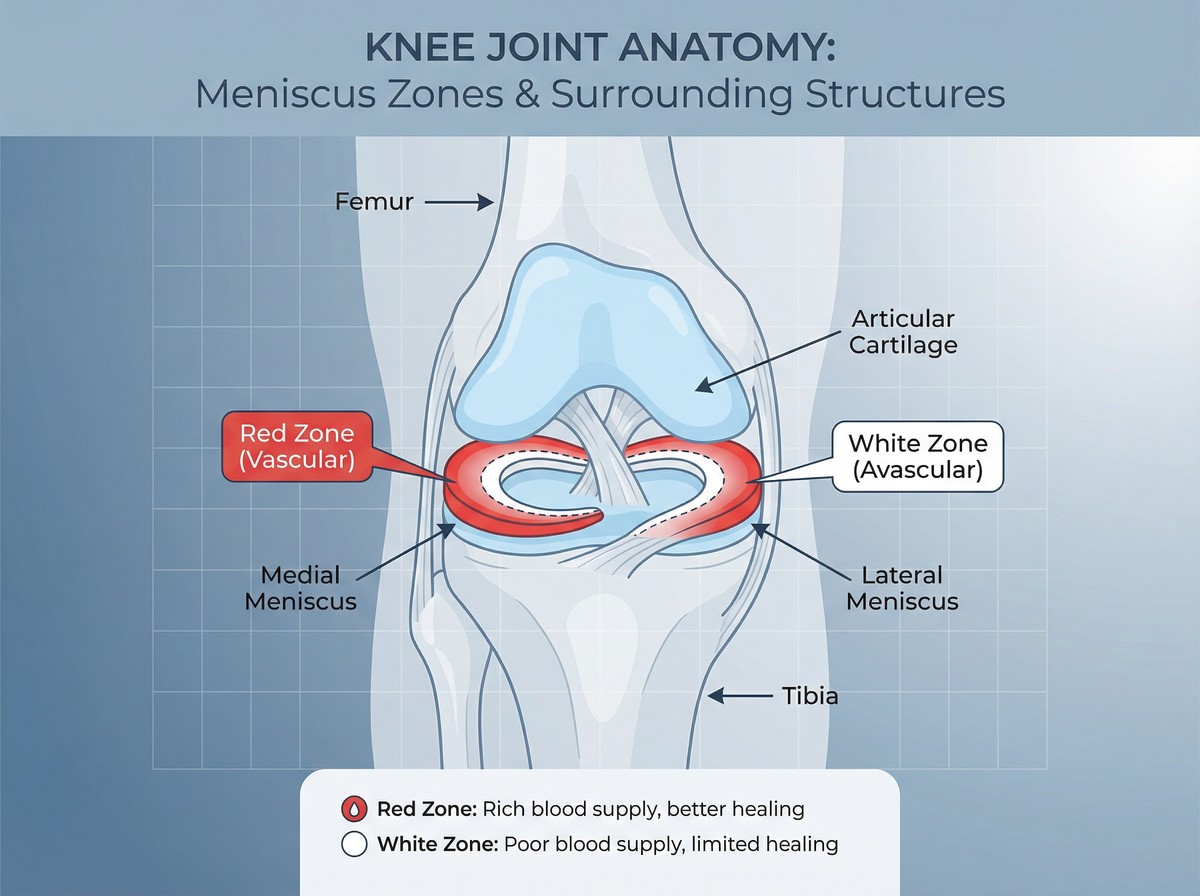
The meniscus acts as a shock absorber between your femur and tibia. Preserving this tissue protects the joint for years to come.

"After my MRI showed a meniscus tear, my orthopedist said surgery was the only option. I wasn't ready to lose part of my knee at 48. Six months after regenerative treatment, I'm back to playing tennis three times a week—something I thought I'd have to give up."

*Name changed for privacy. Photo may feature a model. Individual results may vary.
What the Research Shows
Peer-reviewed studies demonstrate meaningful outcomes for meniscus regeneration
Meniscal Healing Response
MRI-confirmed tissue changes (higher = better)
Based on Whitehouse et al., Stem Cells Transl Med (2017), doi:10.1002/sctm.16-0199
Hurmuz et al. (2024)
Medicina (Kaunas)
Systematic review showing meniscectomy leads to 51% osteoarthritis rate vs 21% with meniscal repair, with significantly lower functional scores (IKDC, Lysholm) after meniscectomy.
0 patients
DOI: 10.3390/medicina60040569 PMID: 38674206
Whitehouse et al. (2017)
Stem Cells Translational Medicine
First-in-human study: 5 patients with avascular meniscal tears treated with MSCs on collagen scaffold. Three of five asymptomatic at 24 months, Lysholm score improved from 59 to 84.
5 patients
DOI: 10.1002/sctm.16-0199 PMID: 28186682
Rhim et al. (2021)
World Journal of Stem Cells
Systematic review of MSC applications for meniscal healing: MSCs suppress inflammation (IL-1β, TNF-α), stimulate collagen production, enhance vascularisation, and improve tissue integration.
0 patients
DOI: 10.4252/wjsc.v13.i8.1005 PMID: 34567422
Understanding Your Options
Compare traditional meniscectomy with regenerative approaches
Note: Some tears may still require surgical intervention. Our specialists evaluate each case individually to recommend the most appropriate treatment path.
Is Regenerative Treatment Right for You?
Our specialists evaluate each guest individually to ensure the best possible outcomes
May Be a Good Candidate
Guests who often respond well to regenerative treatment:
- Meniscus tear confirmed by MRI
- Active lifestyle you want to maintain (tennis, hiking, running)
- Seeking to avoid or delay surgery
- No significant knee arthritis yet
- Committed to post-treatment rehabilitation
May Need Different Approach
Cases that may require surgical intervention:
- Locked knee (bucket handle tear blocking motion)
- Large displaced tear causing mechanical symptoms
- Advanced bone-on-bone arthritis
- Active infection or certain medical conditions
Your Path Back to Activity
Most guests return to their favorite activities within 3 months
Initial Recovery
Light activity resumes. Most guests walk comfortably within days. Inflammation reduction begins.
Growing Strength
Noticeable improvement in knee stability. Light cycling, swimming, and walking distances increase.
Return to Activity
Significant functional gains. Most guests return to hiking, tennis, and recreational sports with confidence.

Peak Results
Continued tissue remodeling. MRI studies show ongoing improvement in meniscal structure and joint health.

Ready to Explore Your Options?
Take the first step toward staying active. Our free assessment helps determine if regenerative treatment is right for your meniscus tear.
Your $5,999 Discovery includes a $5,000 credit toward any program — making your net investment just $999.
No obligation. Appointments available within 48 hours. Insurance verification included.
Questions guests ask about meniscus tears
When is surgery still necessary for a meniscus tear?
Tears that cause the knee to lock or give way, or large traumatic tears, may still require surgical treatment. Degenerative tears are more often explored with non-surgical regenerative options. A physician assessment determines what is appropriate for your knee.
What types of meniscus tears are typically assessed?
The partner clinic commonly assesses degenerative meniscus tears alongside early knee osteoarthritis. Suitability depends on the tear pattern shown on MRI and your overall health.
Is stem cell therapy for a meniscus tear approved by the FDA?
Stem cell therapies are not FDA-approved in the United States for a meniscus tear, and the FDA has not evaluated these treatments. Care is delivered abroad by licensed physicians at our Sterling-certified partner clinic in Bangkok, Thailand. The information here is educational, is not medical advice, and individual results vary.
Am I a candidate for regenerative therapy for a meniscus tear?
Candidacy depends on your diagnosis, imaging or test results, overall health, and goals — not everyone is a suitable candidate. The free Sterling assessment reviews your situation in a few minutes, and final eligibility is confirmed on-site after comprehensive bloodwork and a consultation with the physicians at our partner clinic.
How much does treatment cost?
The Discovery Experience is $5,999 and includes a $5,000 credit toward any extended program chosen on the same trip. Because the recommended approach is personalised after your on-site bloodwork and physician assessment, extended-program costs are shared in context rather than published in advance. Begin with the free Sterling assessment to understand the path that fits you.
Who provides the treatment?
Sterling Longevity is a wellness-travel concierge, not a medical provider. We vet partner clinics, coordinate your entire journey, and support you for 12 months — while the treatment itself is delivered by independently licensed physicians at our Sterling-certified partner clinic. You can read how care is governed.
How soon might I notice a change after treatment?
Timelines vary by individual and condition. Some guests describe gradual changes over several weeks to a few months, while others notice less. Regenerative outcomes are not guaranteed, and no specific result can be promised.
Can I travel home after treatment?
Treatments are delivered on an outpatient basis during your stay in Bangkok, and most guests fly home as planned once their program is complete. Your travel timing is confirmed with the physicians at our partner clinic, and Sterling coordinates airport transfers plus 12 months of follow-up support.